
Managing multiple farm gates across sprawling properties eats up valuable time and fuel costs, especially during busy seasons when you’re making dozens of trips daily. Solar-powered automatic gate openers eliminate this inefficiency by letting you operate gates remotely while staying in your vehicle, powered entirely by renewable energy without requiring expensive electrical trenching or ongoing hydro costs.
For Canadian farm operations, solar gate automation has evolved from a convenience into a practical necessity. Modern systems now feature cold-weather battery technology and panels sized for our variable sunlight conditions, making them reliable even through harsh prairie winters or coastal cloud cover. The technology pairs photovoltaic panels with deep-cycle batteries to store sufficient power for operation during low-light periods, while cellular or radio controls let you trigger gates from up to a kilometer away.
The investment typically ranges from $1,200 to $3,500 depending on gate size and automation features, but most operations recover costs within two years through labor savings alone. Whether you’re managing cattle rotations, securing equipment yards, or controlling access to multiple field entrances, understanding how solar gate openers function in agricultural settings and selecting systems matched to your specific climate zone will determine whether this technology delivers genuine operational value or becomes an expensive disappointment.
Why Farm Gate Automation Makes Sense
Managing farm operations means constantly balancing efficiency with the countless daily tasks that demand your attention. Automating your farm gates might seem like a small upgrade, but it delivers substantial practical benefits that directly impact your bottom line and daily workflow.
During peak seasons like planting and harvest, time becomes your most valuable resource. Manually opening and closing gates multiple times per day adds unnecessary delays when every minute counts. With automated gate systems, you can enter and exit fields without leaving your vehicle, saving precious hours over the course of a busy season. This efficiency gain becomes even more significant when you’re moving equipment between multiple fields or making frequent trips to storage areas.
Biosecurity has become increasingly important for Canadian farms, particularly in livestock operations. Automated gates help you control access points more effectively, reducing the risk of disease transmission from unauthorized visitors or vehicles. You can monitor who enters your property and when, creating a documented trail that supports your biosecurity protocols.
The physical toll on your vehicles matters too. Repeated stop-and-start operations at manual gates contribute to brake wear, transmission stress, and increased fuel consumption. These costs add up, especially when operating heavy equipment or pulling loaded trailers.
For farms with gates located far from main buildings—a common scenario across Canada’s expansive agricultural landscape—automation eliminates the need for long walks in harsh weather conditions. Whether you’re dealing with winter cold snaps or muddy spring conditions, staying in your vehicle improves both comfort and safety. Modern farm automation solutions address these challenges while enhancing overall property security through controlled access and optional monitoring features.
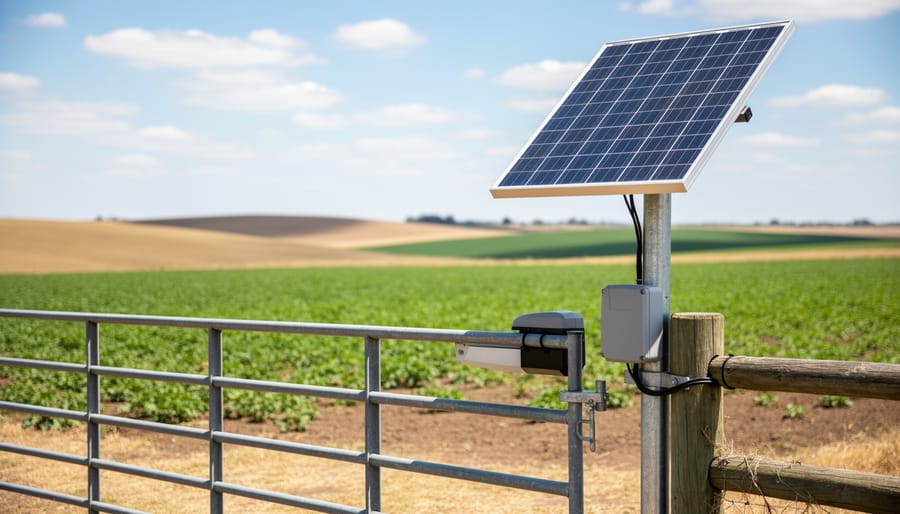
How Solar-Powered Gate Openers Work
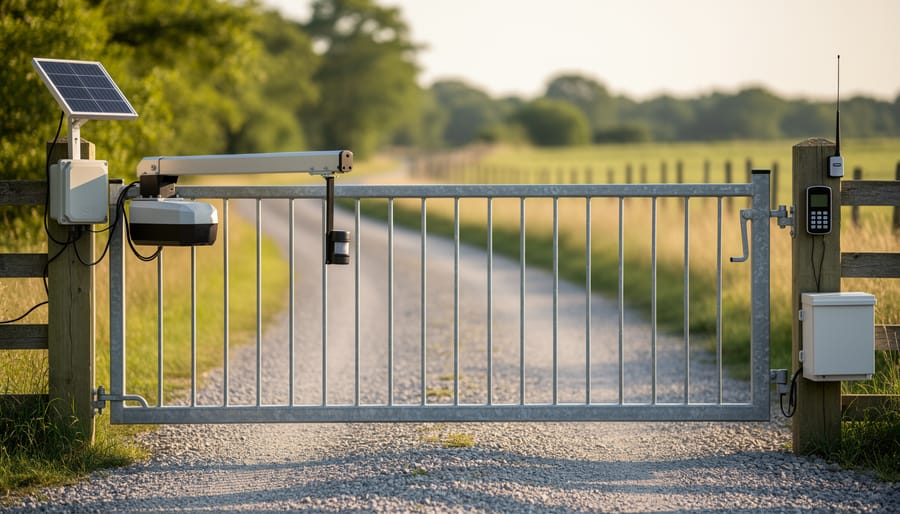
Essential Components
A solar farm gate opener system consists of five key components that work together to provide reliable, off-grid automation. The solar panel captures sunlight and converts it into electrical energy, typically ranging from 10 to 30 watts depending on your gate’s size and usage frequency. This energy charges the battery backup system, usually a 12-volt deep-cycle battery that stores power for nighttime operation and cloudy days—particularly important during Canadian winters when sunlight hours are limited.
The gate operator motor is the mechanical heart of the system, responsible for physically opening and closing your gate. These motors vary in strength based on gate weight and width, with options for swing gates and sliding gates. The control board manages all operations, coordinating power flow from the solar panel and battery while processing commands from your remote or access device. It also includes safety features like obstacle detection and automatic closing timers.
Finally, remote access options range from basic handheld transmitters to smartphone-enabled systems with wireless connectivity, allowing you to control gate access from anywhere on your property. When properly matched and installed, these components create a self-sustaining system that eliminates the need for trenching electrical lines across your property.
Power Requirements and Battery Backup
Most solar-powered farm gate openers require a 10-20 watt solar panel paired with a 12-volt battery system to ensure reliable operation. In Canadian conditions, particularly during winter months with reduced daylight, battery capacity becomes critical. A quality deep-cycle battery with at least 7-12 amp-hours provides sufficient reserve power for continuous operation even during cloudy periods or snowfall.
For typical farm applications, expect 10-30 gate cycles per day. During summer, solar power systems easily recharge batteries between uses. However, Canadian winters present unique challenges. Shorter daylight hours—sometimes as few as 8 hours in northern regions—and snow coverage on panels can limit charging capacity. Choose systems with battery capacity rated for 5-7 days of operation without sunlight to maintain reliability during extended cloudy periods.
Consider positioning solar panels at steeper angles (50-60 degrees) to minimize snow accumulation and maximize winter sun exposure. Many Canadian farmers find that oversizing their solar panel by 25-50 percent provides the buffer needed for year-round dependable performance, particularly in regions experiencing harsh winters.
Choosing the Right Solar Gate Opener for Your Farm
Gate Type and Weight Considerations
Selecting the right solar gate opener starts with understanding your gate configuration. Farm gates typically come in two styles: swing gates that open inward or outward on hinges, and sliding gates that roll along a track. Swing gate openers are generally more affordable and easier to install, making them popular for lighter agricultural applications. Sliding systems work better for wide openings or uneven terrain where swing clearance is limited.
Gate weight is the critical factor in motor selection. Most farm gates range from 100 to 800 pounds, though heavier commercial gates can exceed 1,000 pounds. A typical residential-style farm gate (12-16 feet, wood or vinyl) weighs around 200-400 pounds and requires a motor rated for at least 500 pounds to ensure reliable operation and longevity. Heavier steel or ornamental gates need industrial-grade operators rated for 800+ pounds.
Canadian farms often deal with metal gates that expand and contract with temperature swings, adding resistance. Always choose an opener rated 30-50% above your actual gate weight to account for wind resistance, snow accumulation, and mechanical friction. Consult with equipment suppliers who understand regional conditions to match the appropriate motor capacity with your specific gate specifications and expected duty cycle.
Climate and Weather Durability
Canadian winters demand robust solar gate openers designed for extreme conditions. Quality systems should operate reliably in temperatures ranging from -40°C to +40°C, which covers most agricultural regions across the country. Look for models with winterized batteries specifically rated for cold-weather performance, as standard batteries lose significant capacity below freezing.
Snow and ice resistance is essential. The solar panel should mount at an adjustable angle to prevent snow accumulation and allow easy clearing when necessary. Gate mechanisms need proper weatherproofing with sealed enclosures protecting electronic components from moisture infiltration. Heavy-duty seals and gaskets prevent ice buildup in moving parts that could cause operational failures during critical periods.
Wind exposure presents another challenge, particularly in prairie regions. Choose openers with sufficient torque to handle gates affected by strong winds, and ensure the solar panel mounting system can withstand high wind loads without damage. Many Canadian-specific models include reinforced brackets and wind-rated panels designed for agricultural applications.
Consider systems with battery backup capacity for 7-10 days of operation during prolonged cloudy periods common in Canadian winters. This ensures your gates remain functional even when solar charging is minimal, maintaining accessibility throughout the year.
Access Control Options
Solar-powered farm gate openers support various access control methods to suit different operational needs. Remote controls remain the most popular option, offering simple operation with ranges up to 300 metres—ideal for single-family farms or operations with few regular users. For properties requiring enhanced property security and multiple user access, keypad systems allow customizable entry codes that can be changed seasonally or when staff changes occur.
Smartphone app-controlled systems provide the most flexibility, enabling farmers to grant temporary access to delivery drivers or contractors remotely and monitor gate activity from anywhere. These work reliably with cellular connectivity, though service coverage should be verified in rural Canadian locations. Sensor-based systems using RFID tags or vehicle detection work well for high-traffic operations, automatically opening gates for authorized vehicles without requiring drivers to stop. Consider your daily traffic patterns, number of users, and security requirements when selecting access controls—hobby farms typically manage well with basic remotes, while commercial operations benefit from multi-user digital solutions.
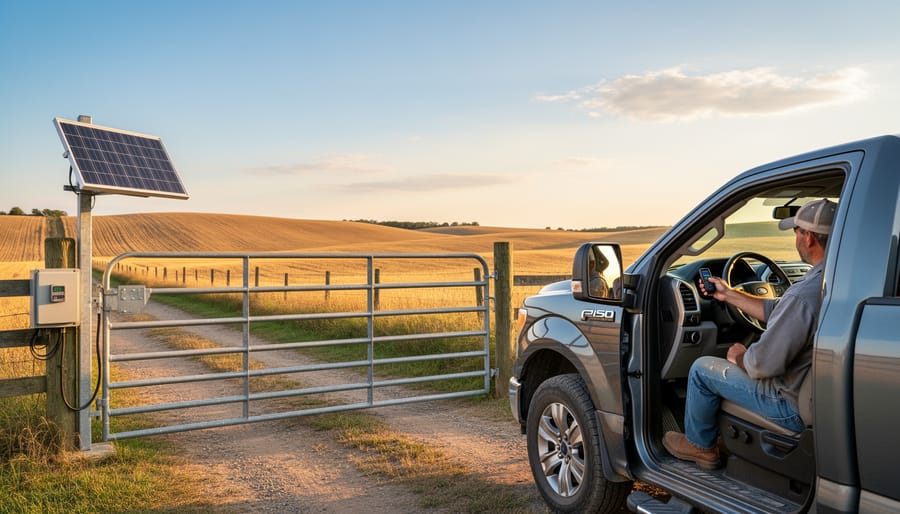
Installation Considerations for Farm Gates
Site Assessment and Solar Panel Placement
Successful solar gate opener performance begins with proper site assessment. Start by evaluating sun exposure at your gate location throughout all seasons. In Canada, the sun’s angle changes dramatically between summer and winter, with winter sun sitting much lower on the horizon. This means panels need strategic positioning to capture adequate light year-round, especially during shorter winter days when sunlight is most limited.
Position solar panels facing true south when possible, angled at approximately your latitude plus 15 degrees for optimal winter performance. Most gate opener kits include adjustable mounting brackets to fine-tune this angle. Walk your property at different times of day to identify potential shading issues from buildings, barns, silos, or tree lines. Even partial shade can significantly reduce charging efficiency, so choose a mounting location with maximum exposure from 9 AM to 3 PM, when sunlight is strongest.
Consider seasonal changes in your landscape. Deciduous trees bare in winter may seem harmless, but their summer foliage could block critical sunlight. Similarly, snow accumulation on panels or mounting posts requires attention in Canadian climates. Ensure panels are positioned high enough and angled steeply enough to encourage snow shedding, maintaining consistent power generation throughout winter months when your livestock gates still need reliable operation.
DIY vs. Professional Installation
Many farm owners can successfully handle basic solar gate opener installations themselves, particularly if they have experience with electrical systems and basic construction. A straightforward single-gate system on stable posts typically requires standard tools like drills, wrenches, and wire strippers, along with about 4-8 hours of work. You’ll need to mount the opener mechanism, install the solar panel in an optimal position, run wiring, and program the system. If your gate is already properly hung and posts are structurally sound, DIY installation becomes much more manageable.
However, professional installation makes sense in several scenarios. Complex dual-gate systems, installations requiring new post construction, or setups needing extensive underground wiring often justify the expertise. Canadian winters present unique challenges—professionals understand proper depth for frost-free wiring burial and can ensure solar panels are positioned to maximize limited winter sunlight. The typical professional installation costs $300-800 in labour but includes warranty protection and proper system calibration.
Consider your realistic time availability during busy farming seasons. A botched DIY installation can lead to frustrating troubleshooting when you need reliable gate access most. If you’re mechanically inclined and have slower winter months for the project, DIY can save money. But if electrical work makes you uncomfortable, or your operation can’t afford downtime from a malfunctioning gate, professional installation provides peace of mind. Many suppliers offer hybrid options—you handle basic mounting while electricians complete the wiring and programming.
Costs and Long-Term Value
Initial Investment Breakdown
Solar-powered farm gate openers typically range from $800 to $2,500 for a complete system, including the opener mechanism, solar panel, battery backup, and necessary mounting hardware. In comparison, hardwired electrical gate openers cost between $600 to $1,800 for equipment alone, but require significant additional expenses for installation.
The real advantage becomes clear when you factor in electrical connection costs. Running power lines to a remote gate often requires trenching anywhere from 100 to 500 meters or more on farm properties. Professional trenching and electrical work averages $15 to $30 per meter in Canada, potentially adding $1,500 to $15,000 to your project—costs entirely eliminated with solar systems.
For Canadian farms, solar gate openers deliver immediate cost savings by avoiding these infrastructure expenses. The higher upfront equipment cost is typically offset within the first installation, making solar the more economical choice for most agricultural gate applications, particularly on properties where gates sit far from existing power sources.
Maintenance and Operating Costs
Solar farm gate openers offer exceptional value through minimal ongoing costs. Unlike manual gates that consume valuable labor time daily, automated systems operate independently with virtually no recurring expenses. Most quality units require only periodic cleaning of the solar panel to maintain optimal charging efficiency.
Battery replacement represents the primary maintenance cost, typically needed every 3-5 years depending on your system and usage patterns. Backup batteries generally cost between $50-150, making this an affordable long-term investment. Modern lithium-ion batteries often extend this replacement cycle even further.
Canadian farm operators consistently report reliable performance across seasons, with proper installation ensuring functionality even during winter months when daylight hours are limited. The time savings alone—eliminating multiple daily trips to open and close gates—quickly offset the initial investment. Most systems deliver 10-15 years of dependable service with minimal attention, making solar gate automation one of the most cost-effective improvements for agricultural operations.
Maintenance Tips for Reliable Operation
Regular maintenance ensures your solar-powered gate opener operates reliably year-round, even through challenging Canadian weather conditions. Here’s how to keep your system performing at its best.
Solar panels require periodic cleaning to maintain optimal charging efficiency. Dust, pollen, bird droppings, and winter grime can reduce power generation by up to 25%. Clean panels every few months using a soft cloth and mild soap solution, avoiding abrasive materials that could scratch the surface. In agricultural settings with high dust exposure, more frequent cleaning may be necessary.
Battery maintenance is critical for consistent operation. Deep-cycle batteries typically last 3-5 years with proper care. Check battery terminals monthly for corrosion, cleaning them with a wire brush and applying protective spray. Monitor charge levels, especially before winter, ensuring batteries are fully charged as cold temperatures reduce capacity. Consider bringing backup batteries indoors during extreme cold spells if possible.
Winter preparation is essential for Canadian operations. Include gate opener checks in your broader winter equipment care routine. Ensure all mechanical components are properly lubricated with cold-weather grease, inspect seals and weather stripping, and verify that snow buildup won’t obstruct the gate’s path or solar panels.
Common troubleshooting includes checking wire connections if the gate becomes unresponsive, verifying the control panel settings haven’t reset, and confirming the solar panel angle hasn’t shifted. Keep spare fuses and remote batteries on hand for quick fixes. If problems persist, contact your supplier or rental provider for technical support rather than attempting complex repairs yourself.
Solar-powered farm gate openers have evolved into a dependable solution for Canadian agricultural operations, even in challenging winter conditions. Modern systems equipped with proper battery capacity and efficient solar panels deliver year-round performance that transforms daily farm workflow. The convenience of automated gate access eliminates countless trips in and out of vehicles, saving valuable time during busy seasons and harsh weather alike. For farms dealing with heavy equipment traffic or multiple daily entries, the productivity gains quickly justify the investment.
When evaluating whether solar gate automation suits your operation, consider your gate’s location relative to power sources, typical traffic patterns, and seasonal access needs. The technology now offers reliable performance across diverse Canadian climates when systems are properly sized and installed. Whether you’re managing livestock movements, securing property perimeters, or streamlining delivery access, solar gate openers provide a practical, cost-effective alternative to trenching electrical lines across long distances. Take time to assess your specific requirements and consult with suppliers familiar with agricultural applications to find the right solution for your farm.