
Husqvarna Group, a Swedish multinational corporation headquartered in Stockholm, directly manufactures and owns the Husqvarna brand you see on mowers across Canada. This isn’t a licensing arrangement or a rebadged product. The company operates its own production facilities in the United States, primarily in South Carolina and Georgia for residential mowers, while commercial-grade equipment comes from plants in Wisconsin and other specialized locations. Understanding where your equipment originates matters more than you might think.
For Canadian farm and landscaping operations, knowing the manufacturer affects parts availability, warranty service, and long-term equipment value. Husqvarna Group maintains strict quality control across its facilities, but production location can influence which models reach the Canadian market first and how quickly replacement components arrive when you need them. The company also partners with select manufacturers like Kawasaki and Briggs & Stratton for engines, though Husqvarna designs and assembles the complete machines.
This manufacturing structure explains why Husqvarna mowers maintain consistent quality standards whether you purchase or rent them. The direct corporate ownership means design changes, safety updates, and parts compatibility flow through a single chain of command rather than multiple licensees with varying standards.
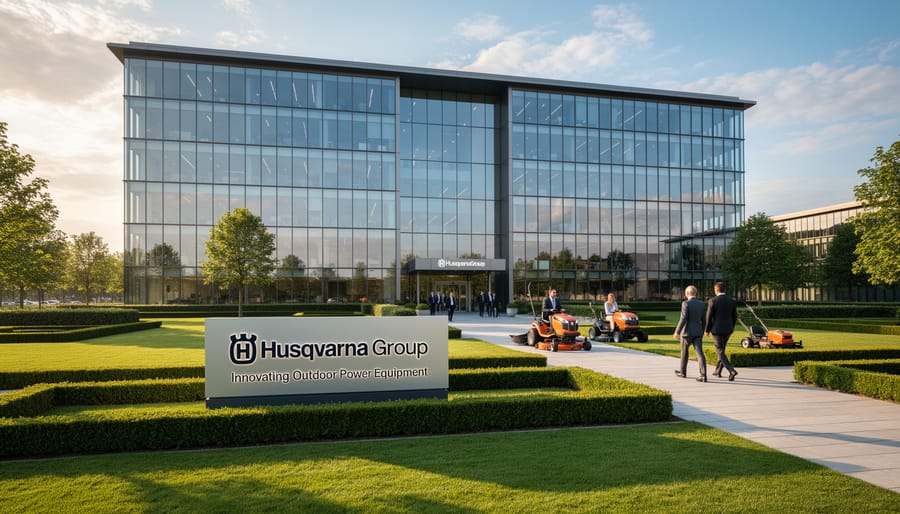
Husqvarna Group: The Parent Company Behind the Brand
Husqvarna Group, headquartered in Stockholm, Sweden, stands as the manufacturer behind Husqvarna mowers. This publicly traded company (listed on Nasdaq Stockholm) operates as one of the world’s largest producers of outdoor power products, with annual revenues exceeding 47 billion SEK in recent years.
The company’s history stretches back to 1689, when it started as a weapons foundry in the Swedish town of Huskvarna. Over three centuries, the company diversified dramatically, producing everything from bicycles and sewing machines to motorcycles before focusing on outdoor power equipment in the mid-20th century. This Swedish engineering heritage still influences product design and quality standards today, even as manufacturing has expanded globally.
Husqvarna Group currently operates through three primary divisions. The Husqvarna division encompasses consumer lawn mowers, robotic mowers, and garden tractors sold through dealers and retailers. The Gardena division focuses on garden tools and watering systems popular in European markets. The Husqvarna Construction division produces equipment for professional contractors, though this remains separate from the lawn care product line most Canadians encounter.
For lawn mowers specifically, the Husqvarna division manages everything from zero-turn commercial mowers used by landscaping crews to residential walk-behind models. The company maintains research and development centres in Sweden and employs over 13,000 people worldwide across its manufacturing, distribution, and service networks.
Understanding this corporate structure matters because Husqvarna Group controls quality standards, parts supply chains, and warranty policies across all manufacturing locations. The Swedish parent company sets engineering specifications and testing protocols that every Husqvarna mower must meet, regardless of where final assembly occurs. This centralized oversight helps explain why Husqvarna maintains consistent quality across its product range, even as actual production happens in multiple countries serving the North American market.
Where Husqvarna Mowers Are Actually Manufactured
Primary Manufacturing Facilities
Husqvarna operates several key manufacturing facilities that produce lawn mowers for global markets, including Canada. The company’s largest North American production hub sits in Orangeburg, South Carolina, where the majority of walk-behind and zero-turn mowers destined for Canadian markets are assembled. This 500,000-square-foot facility has been producing outdoor power equipment since the 1970s and serves as the primary source for residential and commercial mowers sold across North America.
In Europe, Husqvarna maintains production facilities in Sweden and Poland. The Swedish plants focus on premium models and robotic mowers, leveraging the company’s engineering expertise close to its headquarters in Stockholm. Poland’s facilities handle mid-range walk-behind models and components that are distributed throughout European and some North American markets.
China hosts several Husqvarna manufacturing partnerships, primarily producing entry-level residential models and components. These facilities manufacture specific product lines under Husqvarna’s quality oversight, with finished units shipped globally based on market demand.
The company also operates a manufacturing presence in Brazil, which primarily serves South American markets but occasionally supplies specialty models to other regions during peak seasons. Each facility follows Husqvarna’s standardized quality protocols, though the complexity and price point of models varies by location. For Canadian rental operations and commercial buyers, understanding that your equipment likely originated from Orangeburg helps explain the relatively quick parts availability and warranty service you experience.
The North American Production Story
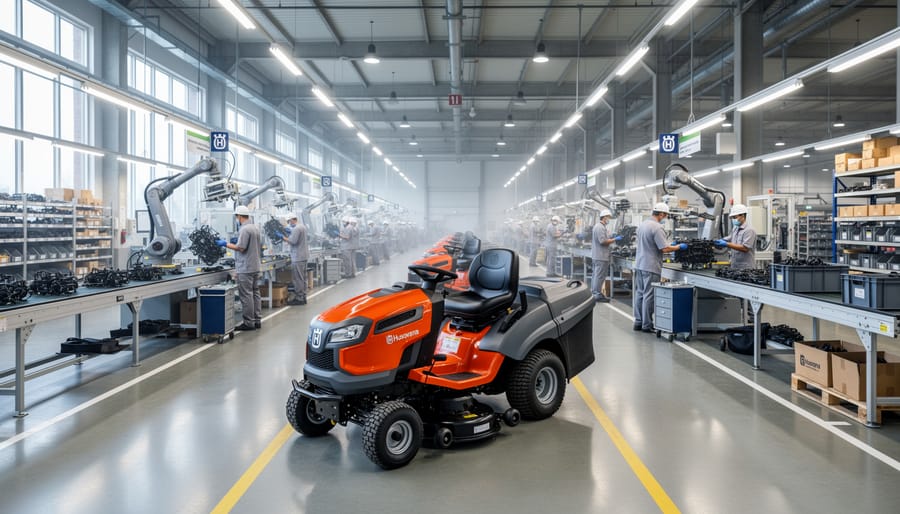
The heart of Husqvarna’s North American production lies in McRae, Georgia, where the company operates its primary U.S. manufacturing facility. This plant, which Husqvarna acquired and expanded significantly over the years, produces a substantial portion of the riding mowers and zero-turn models that reach Canadian dealers and rental operations.
The McRae facility manufactures several key product lines specifically for the North American market. Most residential and commercial riding mowers bearing the Husqvarna name come from this location, including popular models in the TS and MZ series that Canadian landscapers frequently rent. The plant handles everything from frame fabrication to final assembly, with components sourced from both domestic and international suppliers.
For commercial-grade equipment, the story gets more nuanced. While the McRae plant produces many commercial zero-turn mowers, certain specialized commercial models and walk-behind units arrive from Husqvarna’s European facilities. The company’s robotic mowers, which are gaining traction in the Canadian market, come exclusively from Sweden regardless of where they’re sold in North America.
Push mowers and smaller walk-behind models typically originate from Asian manufacturing partners, then ship to North American distribution centers. This matters for Canadian rental businesses because it affects replacement part lead times and service considerations. Equipment manufactured in Georgia generally means faster parts availability through the North American supply chain compared to imports requiring overseas shipping.
The proximity of U.S. manufacturing to Canada provides practical advantages. Shorter supply chains mean rental operations can restock inventory more quickly during peak season, and warranty service tends to be more straightforward when dealing with domestically produced units.
Understanding Husqvarna’s Manufacturing Partnerships
Husqvarna doesn’t manufacture every component in-house, and understanding this reality is crucial for Canadian professionals evaluating equipment reliability. Like most modern manufacturers, Husqvarna relies on a network of suppliers and strategic partnerships to produce the complete mowers you rent or purchase.
The company sources engines from established power equipment manufacturers, primarily Briggs & Stratton and Kawasaki, depending on the model and market segment. This partnership approach allows Husqvarna to focus on what they do best: designing cutting decks, drive systems, and integrating components into cohesive machines while leveraging specialized expertise for critical systems like engines and transmissions.
Husqvarna’s supplier model extends beyond engines to various specialized components. The company maintains relationships with multiple tiers of suppliers, from raw materials to finished assemblies, across their global manufacturing footprint. This distributed approach means your Husqvarna mower likely contains components from several countries, even if final assembly happens in one location.
Key manufacturing partnerships include:
- Briggs & Stratton engines for residential and light commercial models sold in North America
- Kawasaki engines for commercial-grade zero-turn and stand-on mowers
- Hydro-Gear transmissions for hydrostatic drive systems in many residential and commercial units
- Regional suppliers for stamped steel decks, plastic components, and hardware depending on assembly location
For rental businesses and agricultural operations in Canada, this partnership structure has practical implications. Parts availability depends not just on Husqvarna’s distribution network but also on these component manufacturers. The good news is that common engine parts from Briggs & Stratton or Kawasaki are widely stocked across Canada, making repairs faster and rental downtime shorter. However, it also means that when evaluating a Husqvarna mower, you’re really assessing the quality of the entire supply chain, not just one manufacturer’s output.
Quality Control and Design: Where the Engineering Happens
Where Husqvarna mowers roll off assembly lines tells only part of the story. The engineering and quality standards that define these machines originate thousands of kilometers away in Sweden, where Husqvarna’s core design teams have operated for over three centuries.
Husqvarna Group maintains its primary research and development centers in Stockholm and Huskvarna, Sweden. These facilities house the engineers who design cutting decks, develop engine specifications, and establish the testing protocols that every mower must pass, regardless of where it’s eventually assembled. When you rent or purchase a Husqvarna mower in Canada, you’re getting equipment shaped by Swedish engineering principles focused on durability in demanding climates and extended operational life.
The company’s quality control framework operates on two levels. At headquarters, engineers create detailed specifications for materials, tolerances, and performance benchmarks. Manufacturing facilities worldwide must then meet these standards through rigorous testing at multiple production stages. Each plant receives identical testing equipment calibrated to Swedish standards, and random samples from every production run undergo verification against master specifications maintained in Sweden.
This centralized engineering approach explains why Husqvarna mowers assembled in different countries maintain consistent performance characteristics. A residential zero-turn manufactured in Tennessee follows the same cutting deck geometry, blade tip speed, and structural specifications as models produced elsewhere, because those parameters were locked in during the Swedish design phase.
For Canadian rental operations, this matters practically. Parts compatibility remains consistent across manufacturing origins, technicians can apply uniform maintenance procedures, and warranty claims follow standardized processes regardless of a unit’s production facility. The Swedish engineering core provides the continuity that makes fleet management viable.
What This Means for Canadian Agricultural and Landscaping Professionals
For Canadian agricultural and landscaping professionals, understanding Husqvarna’s manufacturing footprint translates directly into practical business advantages. The company’s U.S.-based production facilities in the southeastern states mean shorter supply chains for replacement parts and faster turnaround times when equipment needs service. When you rent a Husqvarna commercial mower or purchase one for your operation, you’re tapping into a North American distribution network that keeps downtime minimal.
Parts availability matters significantly during peak season. A commercial landscaping crew can’t afford to wait weeks for a replacement deck belt or spindle assembly. Husqvarna’s network of authorized Canadian dealers stocks commonly-needed components year-round, and many parts for North American-manufactured models ship from regional distribution centres within days. This infrastructure proves particularly valuable for rental businesses, which need to turn equipment around quickly between customers.
Warranty service follows a similar advantage. Husqvarna Group maintains direct relationships with Canadian dealers and service centres, ensuring warranty claims get processed through established channels rather than complex international procedures. For professional operators, this means clear accountability when equipment issues arise during critical work periods. The company’s long-standing presence in Canada has built service expertise across regions, from Ontario vegetable farms to British Columbia vineyards.
Supply chain predictability in 2026 remains a legitimate concern for any equipment-dependent business. Husqvarna’s diversified manufacturing across North America, Europe, and Asia provides buffer against single-region disruptions. When you evaluate rental equipment or consider a purchase, knowing the manufacturer maintains multiple production sites reduces risk that a facility closure or shipping delay will strand your operation without access to machines or parts. This redundancy built into Husqvarna’s manufacturing strategy offers practical insurance for Canadian professionals who depend on reliable equipment access throughout demanding growing and maintenance seasons.
Husqvarna mowers are manufactured by Husqvarna Group, a Swedish company with production facilities spanning the United States, Europe, and Asia. While the brand maintains its Swedish engineering heritage and quality standards, manufacturing locations vary by model and market demand. For Canadian agricultural and landscaping professionals, this global production network translates to reliable parts availability and consistent service support across the country.
When considering equipment purchases or rentals in 2026, focus less on where a specific mower was assembled and more on Husqvarna’s proven track record of quality control and dealer network strength. The company’s established Canadian presence ensures that whether you’re buying or renting, you’ll have access to parts, service, and support when you need it. Understanding the manufacturer behind the brand helps you make informed decisions, but ultimately, the equipment’s performance and your dealer’s reliability matter most for your operation’s success.